Caramel vs. Crystal Malts:
My memory was not as blurry as I thought. Noonan does differentiate between Caramel malts and Crystal malts in the following way. He writes that Crystal malts are fully saccharified before kilning (thus the glassy endosperm), whereas Caramel malts are not fully saccharified.[1] After discussing the ways in which the production processes differ, he writes the following:
"Caramel malts were traditionally used by continental lagre brewers, whereas crystal malts were favored by British ale brewers. The distinctive, complex flavors of caramel malts have their place in brewing, but unfortunately, modern maltsters are eschewing the production of crisper-flavored crystal malts in favor of the easier-to-process caramel malts. In fact, most modern maltings no longer make a distinction between caramel and crystal malts."[2]
So...is there a difference? Yes. At least there was. Keep in mind that this text was also written eleven years ago. If trends remained the same, then there may be little to no pragmatic difference between caramel and crystal malts. If that's so, then I'm still not sure what the difference is between say, CaraAroma and a crystal malt of a comparable Lovibond rating. I'll have to do some more research before I finally weigh in on this issue.
Second order of business: I brewed an American Amber Ale on Saturday morning. Here's my recipe:
Fermentables:
Maris Otter 62.5%
Munich Type II 31.25%
UK Crystal 60L 3.125%
CaraAroma 3.125%
OG: ~1.065
Hops:
1 oz. Palisade (9.7% AA) 60 min.
1 oz. Athanum (5.1% AA) 15 min.
.5 oz. Palisade 10 min.
.5 oz. Athanum 10 min.
.5 oz. Athanum 5 min.
.5 oz. Palisade @ flameout
Yeast:
Safale S-04
I ended up knocking this batch out in about 5 hours. That even includes the milling of grains. Seems like the process is becoming more refined. There is still one area that is causing me problems - extract efficiency. I calculate my anticipated OG using 65% as the anticipated efficiency. I mashed 16 lbs. of grain at 154F at a rate of 1.1 quarts per pound for ~75 minutes and came up short by 9 GUs. That's an extract efficiency of about 57%. That's quite poor. I did an iodine test to check for proper starch conversion and the resulting color was a deep red, but certainly not black. (The deep red shouldn't be surprising given my mash temp and the inclusion of some darker crystal malts.)
My problem could have to do with many aspects: mash pH, mash thickness, and lautering. I'm still not entirely prepared to jump into the first two right now, but I will be changing my manifold this week to see if that improves yield at all. I hope to post a picture or two of the fully constructed mash/lauter tun later on this week. I plan on using mostly CPVC.
If you'd like to build a cooler-based mash/lauter tun yourself, I would suggest looking at John Palmer's article on the matter.
IBU Dissolution:
For a few weeks now, I've been looking for an answer as to what the theoretical limit of IBU dissolution is. I have not found an answer yet. Tech Talk yielded no useful results. I've emailed my question to the "Ask the Professor" section of Zymurgy, so hopefully something will come up. I'm interested to know because I hear people talking about beers with 100+ IBUs, and it strikes me that the calculations we use as homebrewers to deteremine IBUs can be, well, just wrong. Sure, they can give us a good idea of how much to add for a bittering addition, but it is unlikely that we actually have 35 IBUs in a beer just because a calculation says so. For one, I'd like to know just where the IBU mark ends.
Tomorrow for Technical Tuesday: Mash Thickness.
References:
[1] Noonan, Gregory New Brewing Lager Beer (Brewers Publications, 1996)
[2] Ibid.
Showing posts with label recipes. Show all posts
Showing posts with label recipes. Show all posts
Monday, July 30, 2007

Thursday, July 12, 2007
More IBU Talk + English Mild Recipe
Yesterday I mentioned a number that could be used for expressing how the IBUs in a beer are distributed in regards to bitterness, flavor, and aroma. Thinking about this some more, I decided that it would become really convoluted, but thought that I might provide a general sketch of the idea anyway.
Back to our first example. In Schedule #1, it is probably safe to say that the majority of the bitterness will come from the addition at 60 mins (66 IBUs). So if we set up a system whereby the IBU contributions are expressed as ratios, we'd probably need three.
1.) Bitterness:Flavor
2.) Bitterness:Aroma
3.) Flavor:Aroma
So 1.) might look like 66:18, or 1:3.6. 2 might look like 66:.5, or 1:132. 3 might look like 18:.5, or 1:36.
Is this helpful? Eh, I don't know. It seems to be more trouble than its worth. The trouble becomes more apparent when we talk about beers like the one I posited in Schedule #2. Where does flavor end and aroma begin. If I hop a wort for 2.5 minutes, is that an aroma addition or a flavor addition? Should this depend on the IBU contribution of the particular addition? If so, how?
I'm not sure that this would be very useful, especially for beginning brewers. And, as Bouckaert would surely point out, this still doesn't say much more about flavor.
It's probably okay to ditch this idea, or at least table it for now.
Recipe:
I brewed an English Mild last week for the first time! It's not ready yet, but I think I'm in love with the style already. Here are some reasons: 1.) Fermentation was complete in all of five days. 2.) It cost me less than $20 for all the ingredients to make 5 gallons. 3.) The ABV is sufficiently low such that I could just nurse it all day. 4.) It's tasting really nice already! This may just become the house beer.
Fermentables:
5 lbs. Mild Malt (~72%)
.5 lb. British Crystal 60L (~7%)
.5 lb. Brown Malt (~7%)
.5 lb. CaraAroma 120-150L (~7%)
.5 lb. Carafa I (Dehusked) (~7%)
Hops:
.75 ozs. East Kent Goldings (6.2% AA) Just a bittering addition
Yeast:
Safale S-04 (Quickly becoming one of my favorite yeasts)
Mashed at 155F for about 70 minutes.
OG: ~1.045
FG: ~1.011
ABV: ~4.5%
I still seem to have achieved close to 75% AA despite my inclusion of such a high percentage of specialty malts and a high mash temp. I think I may have to mash a bit higher next time to get a more dextrinous wort.
I'm really excited for this beer. I've been on a low alcohol beer kick as of late, and I think this will be one of the best so far. I intend to compete with this beer when the time comes. I'm also ready to drink it!
Friday, June 22, 2007
Where Did I Go? Also, Pitching Rates.
Clearly most of this week fell by the wayside. I spent the past few days recovering from some bizarre summer cold and catching up on work missed due to said cold. That was then. This is now.
Technical Tuesday will have to wait until next week. Also, it will not be a discussion of redox reactions. 1.) I don't know all that much about redox reactions. 2.) As far as improving your practical homebrewing goes, I'm not sure knowing a bunch about the relevant redox reactions would help you make much better beer than you already do. Instead, I'll focus on alpha- and beta-amylase. Much more pertinent, interesting (in my opinion), and a topic that I have a better grasp on. Makes sense, yes? Yes.
You may remember the Summer Gold from last week. What I hadn't mentioned up until now was how far off I was on achieving my target original gravity. I was off by close to 25 points. That's a big difference! So what was supposed to be around 5.5% ABV, is currently just a little over 3%. Not a problem! I'll just call it a light Summer Bitter. But ya know, with German noble hops...er...that's a style, right? Uh...whatever, I'll drink it. I bet you'd probably like it too.
I called up George from Home Sweet Homebrew to see if he could troubleshoot from the other side of the city. He suggested that I mash a bit longer and sparge a bit slower. I'm going to give that a shot when I brew today. I'll be making a Belgian-style Pale Ale. Here's the recipe:
Fermentables:
10 lbs. German Pils
1 lb. Dark Munich (6-10 Lovibond)
1 lb. CaraHelles
.5 lb. Demerara
Hops:
Styrian Aurora (7.6% AA)
Shooting for around 20-30 IBUs
Yeast:
Wyeast 3522 Ardennes
The yeast starter has been made. I'll be able to get started as soon as I get home with any luck.
Yeast & Proper Pitching Rates:
Funny story. A few months ago I was shocked to learned that homebrewers tend to underpitch. I had been brewing for close to two years and not really giving my worts enough yeast to do the job right. To be honest, I felt (and to some extent, still feel) a bit misled. I'm not saying I call shenanigans or anything like that, I just wish this had been more clear from the outset.
Let's take a quick look at some numbers as per Jamil's site on the topic. I won't reproduce the calculations here, but the result is that you need about 180 billion yeast cells for 5.25 gallons of wort at an original gravity of 1.048. For comparison's sake, a Wyeast Activator Smack Pack contains 100 billion cells. That's nearly half! The lesson to be learned here is that if you really want to improve your beers, it looks like making a starter is going to have to become part of your brewing skillset.
Unless you prefer to use dry yeast. Turns out you can get a proper pitching rate for 5.25 gallons of a 1.048 OG wort from one 10g packet of dry yeast. One. I happen to get nice results from the Fermentis Yeasts. Of course, they won't work for everything, but they've been good to me so far. They're less expensive and don't require a starter. Well hot damn!
Funny thing about these dried yeasts is that it turns out I've been overpitching with them. Case in point, the Summer Gold from last week. I ended up using two packets for a wort of a mere 1.030 OG. I realized this a few nights ago, and thoughts of yeast bite crept into my head. I took a hydrometer reading last night and tasted. Not bad! It had gotten down to 1.007, an apparent attenuation of about 77%. It just breaks 3% ABV, making it one of the most sessionable beers I've brewed to date. I just need to put it into bottles so that I can get to drinking it!
Lessons Learned:
1.) Start checking for conversion during mashes with an iodine test.
2.) If you're using liquid yeast for 5 gallons over 1.048, make a starter.
3.) If using dried yeast, only use what you need.
Until next week...
Wednesday, June 6, 2007
Nekromyces
Something on the order of 7-8 weeks ago, I brewed my first Russian Imperial Stout. This is a point of interest for a few reasons:
1.) The beers that I typically brew tend not to hover in these higher echelons of OG (1.096 in this case), 2.) It was my first outdoor brew, 3.) my boil was done on a charcoal Weber grill. Yes, a Weber grill. Apparently the BTU output is sufficiently high to boil 7.5 gallons to 4.5 over the course of a few hours. How many? To be honest, I lost count. Anyway, it's kind of fun to look at, so here are some images from that day:
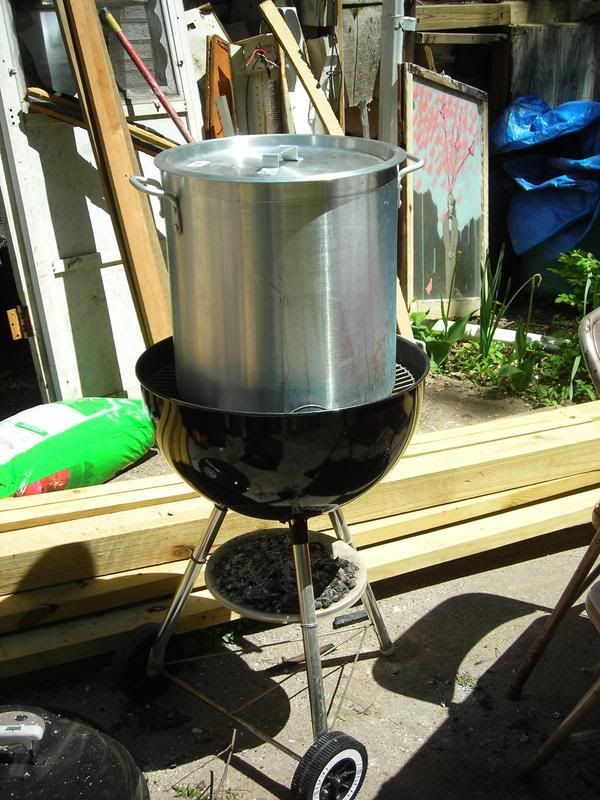
My 50 quart brewkettle straddled across the charcoal flames. Hot.
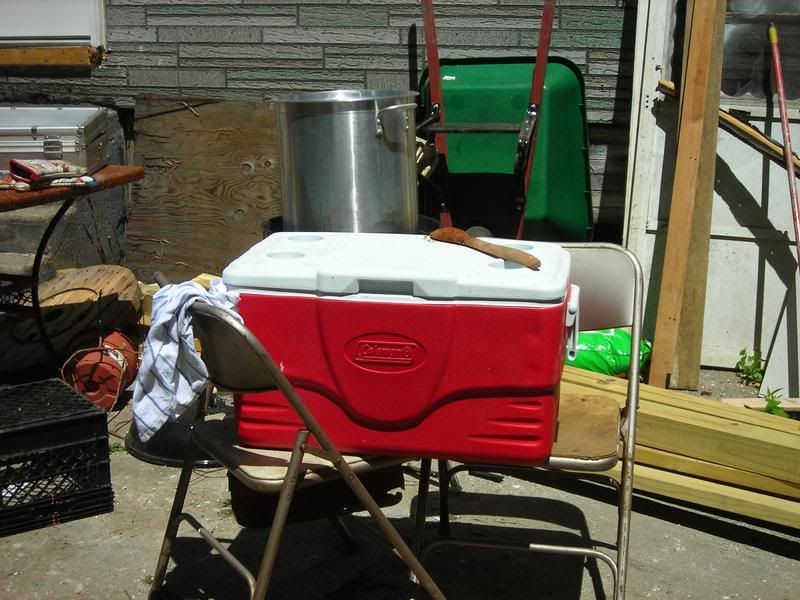
Good old rectangular cooler used as the mashing & lautering tun. Plenty of room even with 19 lbs of grain and 4.75 gallons of water.
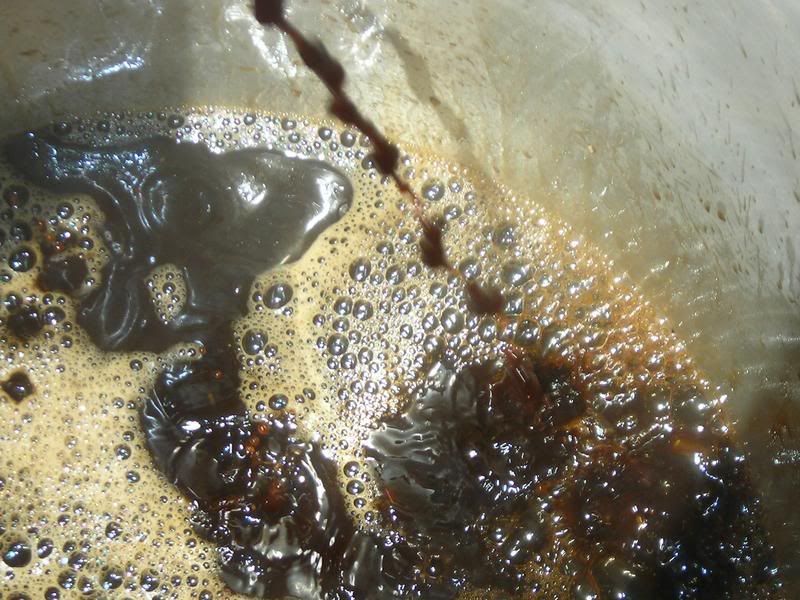
Running hot wort into the kettle.
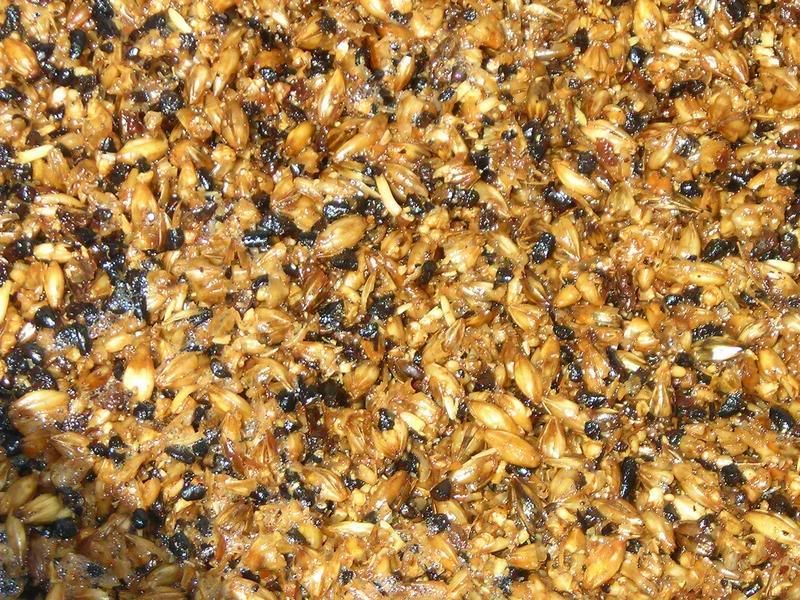
Tasty looking grains, yes?
Finally, here's the recipe used (for ~4.5 gallons):
Grain Bill:
15 lbs. Marris Otter (~80%)
1 lb. British Dark Crystal 150L (~5%)
1 lb. Weyermann Carafa III Dehusked 488-563L (~5%)
1 lb. Weyermann Melanoidin 28-38L (~5%)
1/2 lb. Chocolate Rye 400-500L (~2.5%)
1/2 lb . Flaked Oats (~2.5%)
Hops:
2 oz. Simcoe for boiling
2 oz. Millenium last 15 minutes
Yeast(s)
1056 American Ale
Safale S-04
Safale T-58
OG: 1.096
FG: 1.021
Apparent Attenuation: 78%
ABV%: ~9.8%
1.) The beers that I typically brew tend not to hover in these higher echelons of OG (1.096 in this case), 2.) It was my first outdoor brew, 3.) my boil was done on a charcoal Weber grill. Yes, a Weber grill. Apparently the BTU output is sufficiently high to boil 7.5 gallons to 4.5 over the course of a few hours. How many? To be honest, I lost count. Anyway, it's kind of fun to look at, so here are some images from that day:
My 50 quart brewkettle straddled across the charcoal flames. Hot.
Good old rectangular cooler used as the mashing & lautering tun. Plenty of room even with 19 lbs of grain and 4.75 gallons of water.
Running hot wort into the kettle.
Tasty looking grains, yes?
Finally, here's the recipe used (for ~4.5 gallons):
Grain Bill:
15 lbs. Marris Otter (~80%)
1 lb. British Dark Crystal 150L (~5%)
1 lb. Weyermann Carafa III Dehusked 488-563L (~5%)
1 lb. Weyermann Melanoidin 28-38L (~5%)
1/2 lb. Chocolate Rye 400-500L (~2.5%)
1/2 lb . Flaked Oats (~2.5%)
Hops:
2 oz. Simcoe for boiling
2 oz. Millenium last 15 minutes
Yeast(s)
1056 American Ale
Safale S-04
Safale T-58
OG: 1.096
FG: 1.021
Apparent Attenuation: 78%
ABV%: ~9.8%
Subscribe to:
Posts (Atom)
